

Skin boosters are designed to improve skin quality, hydration and resilience without changing the shape or proportions of the face. However, different treatments work in different ways, from boosting hydration to stimulating collagen.
At Sciene London in Muswell Hill, we choose treatment according to what the skin actually needs, whether that is dehydration and early fine lines or more noticeable thinning, crepiness or loss of firmness.
Newer options include Jalupro, which combines hyaluronic acid with amino acids to support hydration and collagen production, and Juläine, a PLLA biostimulator designed to stimulate collagen gradually.
What Are Skin Boosters and How Do They Work?
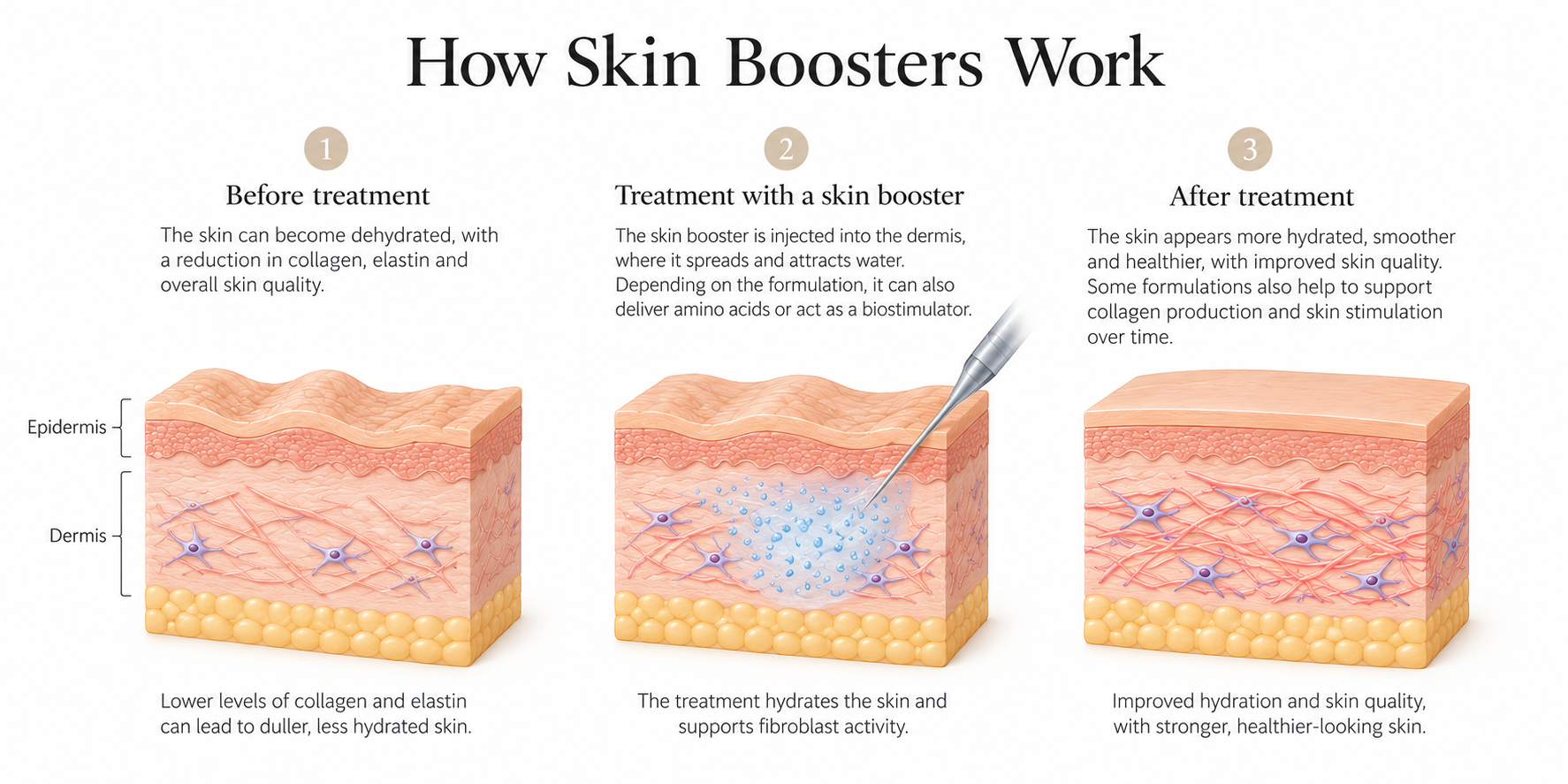
Skin boosters are injectable treatments designed to improve skin quality rather than reshape facial features. Depending on the formulation, they can help with hydration, elasticity, fine lines and overall skin condition, making them particularly useful when skin looks dull, tired or less resilient.
Many contain hyaluronic acid, which attracts and retains water to improve hydration and smoothness. This can be especially useful when the skin has become depleted through factors such as sun exposure, travel or disruption to its normal hydration levels.
Some treatments also focus more directly on stimulation. Jalupro combines hyaluronic acid with amino acids involved in collagen formation, while Juläine, a PLLA collagen biostimulator, is designed to encourage the skin's own collagen production gradually. These approaches become increasingly relevant as collagen production and skin quality change over time.
Who Are Skin Boosters Best For?
There is no particular age at which somebody suddenly "needs" a skin booster. What matters more is the condition of the skin.
For younger patients, the first changes are often subtle. Skin may become dehydrated more easily, look dull or start to show fine lines that become more noticeable when it is dry. In these cases, we may focus on hydration and maintaining skin quality.
As collagen and elasticity reduce, the priorities can shift. The skin may begin to feel thinner, less firm or slightly crepey, particularly around the lower face or neck.
We would therefore consider factors such as:
dehydration and persistent dullness
fine lines and crepey texture
reduced firmness or elasticity
thinning or less resilient skin
early or more established collagen loss
the patient's age, skin condition and previous treatments
The aim is to match the treatment to the skin rather than choosing an injectable because it happens to be popular.
What Is Jalupro and Who Might It Suit?
Jalupro may be considered when the skin looks dehydrated, dull or less elastic, particularly where fine lines and early changes in skin quality are becoming more noticeable.
Rather than adding obvious facial volume, the aim is a gradual improvement in how the skin looks and feels. Depending on the formulation selected and the individual being treated, Jalupro may be considered for areas including the face, neck, décolletage and hands.
For someone whose main concerns are dehydration, fine lines and declining elasticity, it can sit between simple hydration and more intensive collagen stimulation.
When Might We Consider Juläine?
Juläine tends to become more relevant when collagen loss, reduced firmness or skin laxity are more established.
Because it works by stimulating collagen gradually, results develop progressively rather than creating an immediately "filled" appearance.
For relatively firm skin that simply looks dehydrated or tired, this level of biostimulation may not be necessary. Where the skin has become noticeably less firm and resilient, however, a collagen-focused approach may be more appropriate.
Can Skin Boosters Be Combined With Other Skin Treatments?
Yes, particularly when several different skin changes are present. Injectables cannot necessarily address every element of ageing, texture or sun damage, which is where other treatments used at Sciene can play complementary roles.
Depending on your skin, we may consider:
Dermapen Microneedling: For texture and collagen renewal. We can also use microneedling alongside regenerative approaches where improving overall skin quality is a priority.
Radio Frequency Skin Tightening: For reduced firmness and elasticity.
Dermalux LED Light Therapy: To support skin health and recovery as part of a wider treatment programme.
Hydration and barrier support: Where dehydration or barrier health is a concern, we may begin with a more hydration and repair-focused approach before progressing to stronger stimulation.
iPixel Laser Resurfacing: For more significant changes in skin texture where an injectable treatment may not be the most appropriate option.
Combination treatment should address different aspects of the skin rather than simply make a plan more intensive. For milder changes, we may start with one treatment and assess the response, while a staged approach may be more appropriate where dehydration, texture and collagen loss overlap.
Frequently Asked Questions About Skin Boosters
Are Skin Boosters the Same as Dermal Fillers?
No. Although some skin boosters and dermal fillers contain hyaluronic acid, they are designed for different purposes. Dermal fillers are generally used to restore volume, contour or structural support, whereas skin boosters focus primarily on skin quality, hydration and rejuvenation.
Can Skin Boosters Be Used on the Neck?
Yes, certain injectable skin treatments can be considered for the neck, where crepiness, dehydration and reduced elasticity are common concerns. The most appropriate product depends on the degree of skin change and your individual anatomy.
Will Skin Boosters Make My Face Look Puffy?
They are not intended to create the same volume changes as conventional dermal filler. Temporary swelling can occur following injectable treatment, however, and your practitioner should explain expected recovery and potential side effects before treatment.
Can I Have Skin Boosters If I Have Never Had Injectables Before?
Potentially, yes. Previous injectable treatment is not necessarily required. A consultation allows us to assess your skin, medical history and goals before deciding whether an injectable treatment is appropriate.
Are Skin Boosters Only for the Face?
No. Depending on the treatment, skin quality injectables may also be considered for areas such as the neck, décolletage and hands. Treatment areas should always be selected according to the individual product and clinical assessment.
Do I Still Need Skincare If I Have Skin Boosters?
Absolutely. Injectable treatments do not replace a consistent skincare routine or daily sun protection. A well-planned professional skincare routine can help support skin health between appointments and maintain the improvements achieved through in-clinic treatment.
Choosing Skin Boosters in Muswell Hill, North London
Hydration, fine lines, thinning skin, loss of elasticity and declining collagen can look similar at first glance, but they do not always need the same treatment.
At Sciene in Muswell Hill, we assess the skin before deciding whether the priority is hydration, regeneration, collagen stimulation or a combination of approaches. Depending on what we find, that may mean considering treatments such as Jalupro, Profhilo, polynucleotides or Juläine, or incorporating other skin treatments where texture or firmness also needs to be addressed.
If you are considering skin boosters in Muswell Hill or North London, book a consultation with our team so we can assess your skin and recommend an approach based on what it actually needs. We welcome patients from Muswell Hill and surrounding areas including Highgate, Crouch End, Finchley, Hampstead, Barnet and across North London.
