

Dermalux Tri-Wave LED Light Therapy: What Does It Do for Your Skin?
If you have looked into LED light therapy, you will probably have come across red light for skin ageing and blue light for breakouts. Dermalux Tri-Wave LED light therapy takes this further by bringing three clinically recognised wavelengths into one professional system, allowing treatment to be adapted to what is happening within the skin.
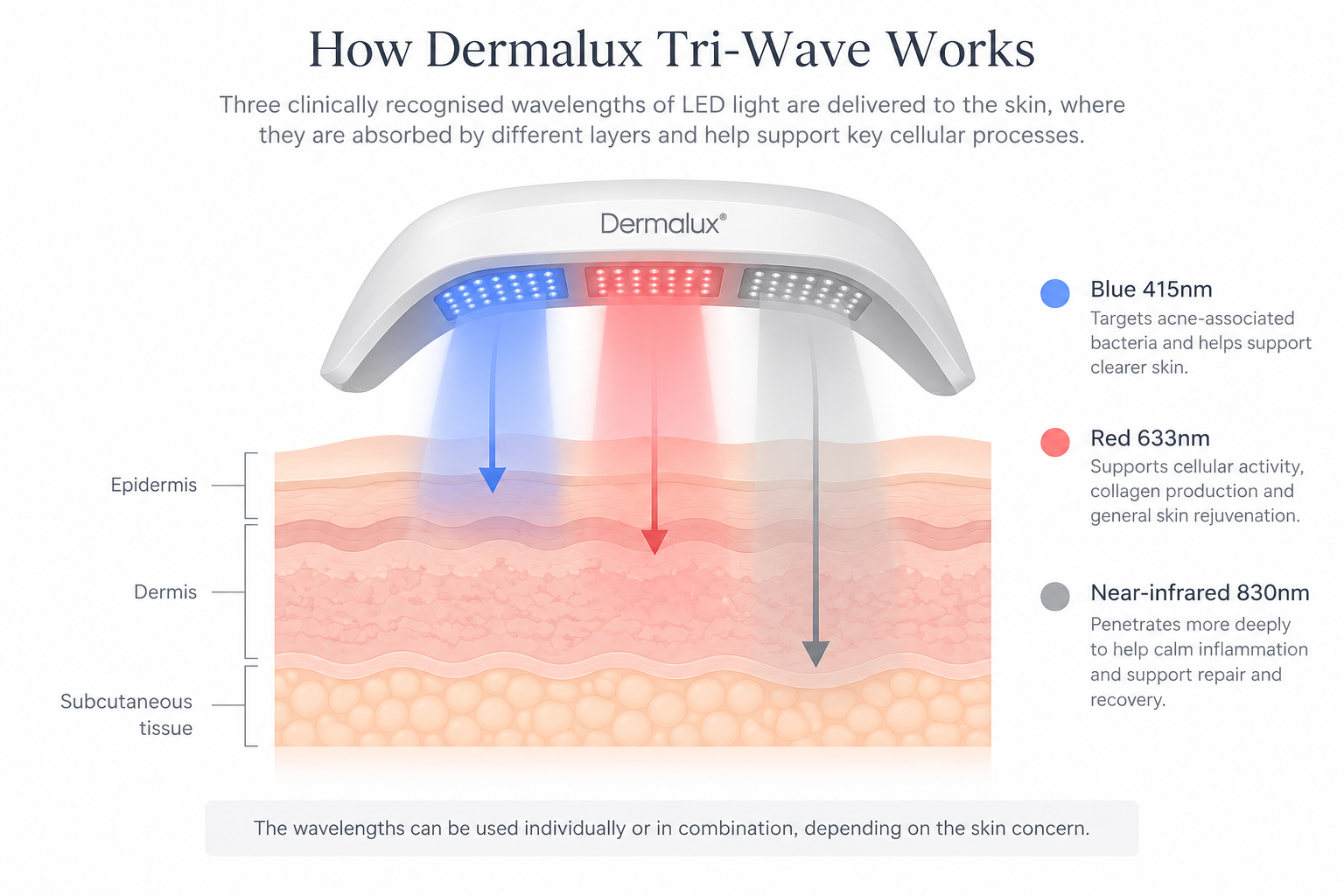
The three wavelengths are blue 415nm, red 633nm and near-infrared 830nm. Each interacts with the skin differently and can be selected, or used in combination, according to the concern being treated.
At Sciene London in Muswell Hill, we use Dermalux for concerns ranging from acne and inflammation to skin rejuvenation, as well as after injectable and other aesthetic treatments to support recovery. Its value lies in choosing the right wavelength for the skin and deciding whether LED is best used alone or alongside another treatment.
What Is Dermalux Tri-Wave LED Light Therapy?
Dermalux Tri-Wave is a professional phototherapy treatment that exposes the skin to specific wavelengths of LED light.
Unlike a laser, peel or microneedling treatment, it does not resurface the skin or create a controlled injury. Instead, selected wavelengths of light are absorbed within the tissue, where they can influence different biological processes. This is known as photobiomodulation.
The "Tri-Wave" refers to three wavelengths:
Blue 415nm, primarily associated with blemish and acne management
Red 633nm, used to support rejuvenation and skin repair
Near-infrared 830nm, which penetrates more deeply and supports recovery and inflammatory responses
These wavelengths can be selected according to the skin concern, rather than every patient receiving the same LED treatment.
Why Does Dermalux Tri-Wave Use Three Different Wavelengths?
Different wavelengths penetrate the skin to different depths and interact with different cellular targets. This matters because acne, inflammation and skin ageing involve different biological processes.
For active blemishes, the focus may be on bacteria associated with acne. For ageing skin, we may want to support cellular activity and fibroblast function. After an aesthetic procedure, the priority may instead be calming inflammation and supporting repair.
Having three wavelengths allows Dermalux to respond to these different needs. Its role can also change over time. Someone may initially use LED to help manage active breakouts, for example, before the focus later shifts towards recovery or improving overall skin quality.
What Does the Blue 415nm Light in Dermalux Tri-Wave Do?
Blue 415nm light is mainly used for active acne and blemish-prone skin. It targets Cutibacterium acnes, one of the bacteria involved in breakouts, helping to reduce bacterial activity and support clearer skin.
Acne can have several contributing factors, so blue LED will not always be enough on its own. If there is more significant congestion, inflammation or uneven texture, we may consider Harmony ClearSkin as part of a wider treatment plan.
What Does Dermalux Red 633nm Light Do for the Skin?
Red 633nm light is used primarily for skin rejuvenation, repair and collagen support. It reaches deeper into the skin than blue light and supports cellular activity, including fibroblasts, the cells involved in producing collagen.
This makes it particularly useful for dullness, early signs of ageing and general skin quality, offering a gentle way to support healthier-looking skin without intensive tightening or resurfacing.
What Is Dermalux Near-Infrared 830nm Light Used For?
Near-infrared 830nm penetrates more deeply into the tissue and is particularly useful for calming inflammation and supporting repair and recovery.
This can make it valuable after treatments that deliberately stimulate the skin, such as microneedling, when the priority shifts from creating a response to supporting the healing process.
Unlike blue and red LED, near-infrared light is invisible to the human eye, so you will not see this wavelength during treatment.
Can Dermalux Tri-Wave Use More Than One Wavelength at the Same Time?
Yes. Skin concerns rarely exist in isolation. Someone with acne may have active blemishes alongside inflammation, while a patient having a rejuvenating treatment may benefit from support for both cellular activity and recovery.
Using wavelengths in combination allows Dermalux to address more than one process where appropriate. This does not mean that using all three is automatically better. The advantage of a multi-wavelength system is the ability to choose the light, or combination of lights, that best matches the skin.
How Does Dermalux Fit Into the Post-Injectable Treatment Journey?
At Sciene, Dermalux is also used after injectable treatments as part of the post-treatment journey. Once the injectable treatment has been completed, the focus moves towards supporting the skin as it settles and recovers.
Red and near-infrared LED can be particularly useful at this stage because of their role in supporting cellular repair and calming inflammation. Dermalux provides a gentle, non-invasive way to support this process without adding further heat, needles or resurfacing to recently treated skin.
This can complement injectable treatments where supporting skin quality and collagen is already part of the wider goal. Sciene's latest injectable offering, JULÄINE™, for example, is a collagen-stimulating treatment designed to encourage the skin's own collagen production over time. Dermalux does not replace or enhance the injectable itself, but can form part of the supportive care around treatment.
The same principle applies across Sciene's injectable treatments. The injectable performs its intended role, while Dermalux is used afterwards to support the skin during the immediate post-treatment period.
Dermalux Tri-Wave vs At-Home LED Masks: What's the Difference?
At-home LED masks may use some of the same principles, but seeing red or blue LEDs does not mean two devices are delivering an equivalent treatment.
With phototherapy, factors including wavelength, treatment dose, intensity, distance from the skin and treatment duration all matter. Dermalux Tri-Wave is a professional system designed around defined wavelengths of 415nm, 633nm and 830nm and controlled treatment protocols.
There is also the benefit of assessment. Before using Dermalux at Sciene, we can establish whether a concern is related to dehydration, inflammation, pigmentation, collagen loss, vascular redness or something else. LED may be appropriate, or another treatment may address the underlying concern more effectively.
This is particularly important for persistent acne, unexplained redness or skin changes that are not improving.
FAQs About Dermalux Tri-Wave LED Light Therapy
Is Dermalux Tri-Wave suitable for darker skin tones?
LED does not work by targeting melanin in the way some pigment-focused technologies do. Suitability should still be assessed individually, particularly where an active skin condition is present.
Does Dermalux Tri-Wave contain UV light?
No. Dermalux uses blue 415nm, red 633nm and near-infrared 830nm wavelengths, which are different from ultraviolet radiation.
Can you have Dermalux if you are using active skincare?
This depends on the products you are using. Certain medications and ingredients can affect light sensitivity, so tell your practitioner about prescription treatments and your current skincare routine before treatment.
Why do you wear eye protection during Dermalux?
Professional LED systems produce very bright light. Appropriate eye protection is used according to the treatment protocol for safety and comfort.
Can Dermalux be used all year round?
Because Dermalux does not resurface the skin or rely on UV exposure, it can form part of a year-round skin programme where appropriate. Daily sun protection remains important throughout the year.
Is Dermalux Tri-Wave Worth Considering for Your Skin?
The key advantage of Dermalux Tri-Wave LED light therapy is its three specific wavelengths, which can be selected according to what the skin needs. Blue 415nm has a role in acne management, red 633nm supports rejuvenation and repair, while near-infrared 830nm can be particularly useful for inflammation and recovery.
Dermalux may be used as a standalone treatment, as part of a wider skin plan or after treatments such as injectables, when supporting the skin through recovery becomes the priority.
At Sciene London in Muswell Hill, we assess the condition of the skin and the treatments you are having before deciding where Dermalux fits. If you are based in Muswell Hill or elsewhere in North London, you can book a consultation or treatment to find out whether Dermalux Tri-Wave is appropriate for your skin.
